
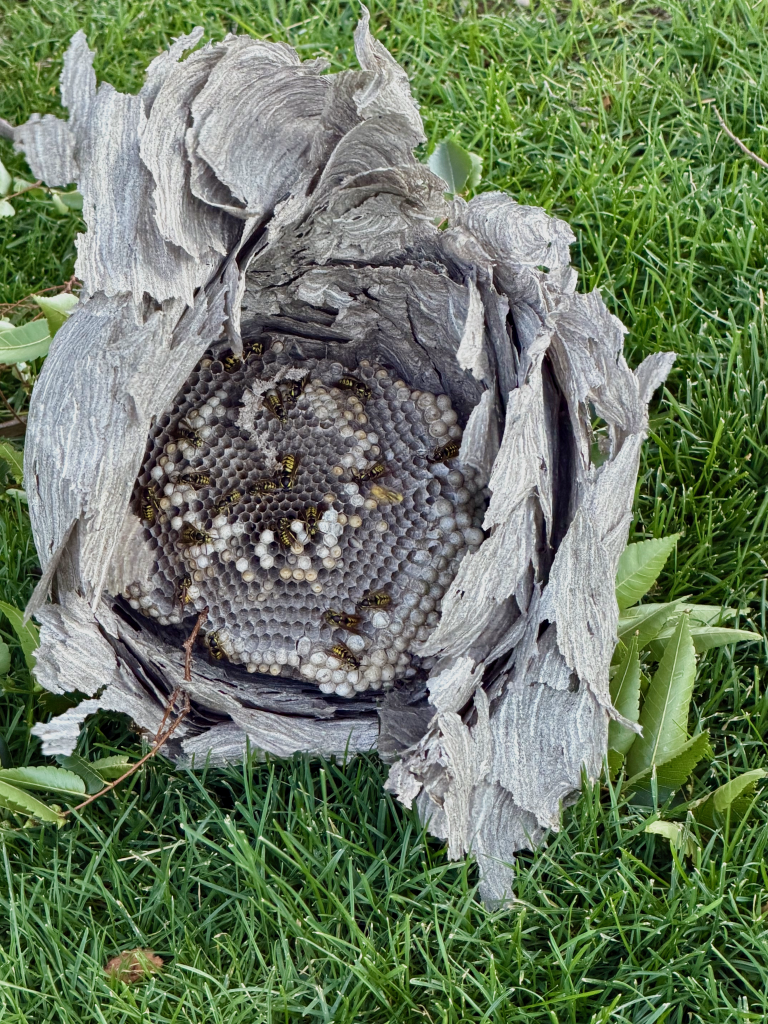
 Late yesterday afternoon, a gust blew down a wasp nest.
Not a little one.
We found it on the grass over toward the river in the park in front of our house, a gray paper mass roughly the size of a basketball, torn open by the fall. Inside were layers of hexagonal cells packed beneath an outer shell that looked remarkably like something made rather than grown.
Which, of course, it was.
There were still wasps crawling over it. So we killed them.
What we did seemed obvious. A large wasp nest had fallen into a public park. People walk there. Kids play there. Picnickers spread blankets nearby. Wasps sting.
Problem solved.
Wasps occupy a strange place in our relationship with nature. We readily understand why we need bees. We’ve practically given them a public-relations campaign: Save the bees. Wasps have no such constituency. Nobody puts a little yellow-and-black sign in the garden saying Save the yellowjackets.
So when one appears, the reflexes come fast.
Except earlier that same day, I’d stopped on the concrete bridge in the middle of the park to watch one.
It was dragging a small spider across the pavement—wrestling with it, adjusting its grip, continuing on. The work looked purposeful. Difficult. Real.
There were others too. I’d hunted out several hexagonal nests tucked deep in the Virginia creeper that covers my garage wall, finally spotting the gray paper against the cream-colored siding, impossibly precise.
Suddenly, I was surrounded by wasps. Or hornets. Or yellowjackets. Or mud daubers.
I realized I didn’t know the difference.
The categories, it turned out, weren’t what I thought. Yellowjackets are wasps. Mud daubers are wasps. Even bald-faced hornets—which, just to make the whole thing more confusing, aren’t hornets at all—are yellowjackets.
Apparently, I’d spent more time avoiding these creatures than learning their names.
The one I’d watched dragging the spider across the bridge wasn’t out looking for trouble. It was working—dragging prey that may have been destined for a mud chamber under someone’s eaves, food for the wasp’s young. The ones hovering low over the lawn weren’t waiting for bare ankles. They were looking for water. Prey. Building material.
The more I watched them, the less they seemed to be aimlessly buzzing around.
They were always doing something.
Then there was the nest itself.
The huge gray structure lying torn on the grass hadn’t been made from paper the way we normally think of paper.
The wasps had made the paper.
They’d scraped fibers from weathered wood, mixed them with saliva, and spread the resulting pulp in thin layers. The color was gray because much of the wood they harvested was already weathered gray. The silver and charcoal swirls were traces of wherever the wasps had gathered.
Now those thin walls lay torn and crumpled in the grass.
Inside were layers of hexagonal cells, most capped with pale plugs. Beneath them, a new generation was developing—pupae ripening toward whatever comes next. Where the fall had broken sections open, the architecture gave way to biology. What had been neatly contained was suddenly exposed.
I had been looking at a nest.
It was a nursery.
Chambers for raising young. Layers of paper protect them from the weather and predators. Workers coming and going. Food gathered. A small city made from spit and wood, now ruined on the ground.
I’m still not sure killing the surviving wasps was the wrong decision. A damaged colony in a public park is different from one hanging high in a tree. Human safety matters.
But I’m interested in how quickly the decision came.
Spider across the bridge: stop and watch.
Wasps on a fallen nest: kill them.
Same afternoon. Different context.
Maybe that’s the uncomfortable thing about the question itself.
We tend to ask what something is for when it annoys us—as though usefulness to us were the price of admission.
This morning, there are mud nests still under my eaves.
For now, I think I’ll leave them there.

I sat under an ornamental Pear tree in Texas once and was surprised, then delighted at the wasps that were devouring an infestation of leaf eating leaf worms. Although I still don’t like yellowjackets as they can be very aggressive. Other wasps are beneficial insects that can serve us… if we let them.