
I spent late Tuesday afternoon hiking up Bunnells Fork.
It’s not a famous trail. Not particularly difficult. Just a good trail tucked away in a canyon that sees far fewer people than it deserves. Seventeen hundred vertical feet in two miles. I committed to that distance to see what I could see.
Not much beyond sheer quiet, some year-old bear scat, and a solo wild turkey.
What it did have was spiders.
Thousands of them.
Or more accurately, thousands of strands of silk stretched across the trail. No webs. Just lines.
Every few steps another one would catch me. Across the eyes. Across the mouth. Around my neck. Across my chest. Sometimes my arms. Sometimes my legs. High, low, and everywhere in between.
By the time I reached the back ridges of Cascade, I’d broken silk every two or three feet. A mile’s worth. More than five thousand strands.
At first it felt like an inconvenience. Then it became a curiosity.
Why do spiders do this?
Many of those spiders weren’t building webs at all. They were putting up bridge lines — releasing a strand into the breeze and waiting for it to catch on the other side. Once anchored, that line becomes a foundation. A pathway. The starting point for something larger.
The spiders weren’t building anything for me. I was simply walking through their work.
Which felt sort of rude, I guess.
What surprised me most was learning how remarkable the material itself is. Weight for weight, some varieties rival steel. Which surprised me, because I had just spent two miles walking through it without slowing down.
Gather enough into a single rope and it could support tens of thousands of pounds.
The strength was always there. It was simply distributed.
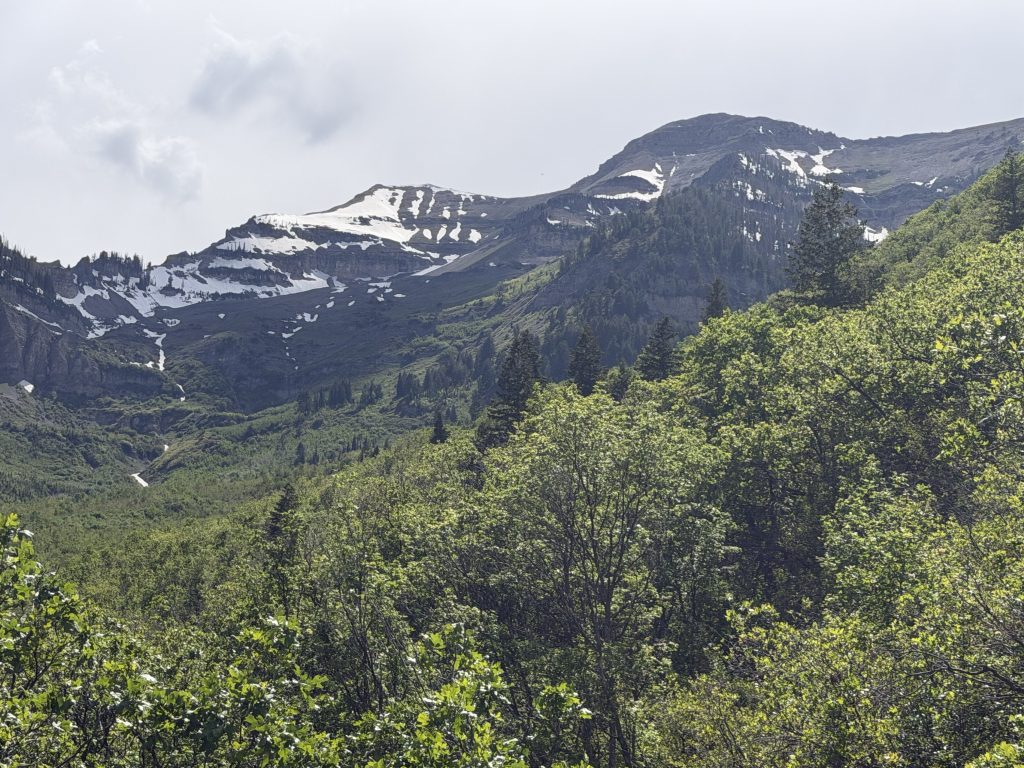
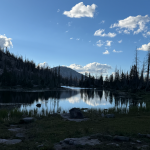
At two miles in I was still in forest, canopy pressing close on both sides. My watch showed 2.08 when the trees opened without warning — and there it was. A long ravine rising above me, a thin thread of creek at the bottom, two peaks still carrying their last snow against a grey sky.
I stood there longer than I meant to.
The summit was up there somewhere. I could see the ridge. I found myself doing the math — distance, elevation, time left in the day — the way you do when you’re already a little past the point of smart.
Then I took inventory.
No water. No food. My only tools were a key fob and a sharp stick I’d picked up somewhere around mile one, which had felt reassuring at the time given the bear scat and the persistent sensation of being watched. My dog Scout, who had been alert and eager for the first hour, had adopted a new defining attribute: dog-tired.
She was not going to save me from anything.
In my younger years I’d have drunk from the creek and kept climbing. That version of me wouldn’t have considered it a real question.
But I’m not that version anymore.
And standing there, I made a quiet deal with myself: come back. Early morning. Water, protein bars, maybe a slightly more credible weapon than a key fob.
Do it right.
I turned around.
The descent was frictionless in a way the climb hadn’t been. The silk was already gone — I had cleared it on the way up without thinking. Thousands of anchor points broken. Whatever the spiders had spent the day building, I had spent the afternoon undoing.
I thought about the ones who’d crossed their bridge lines that morning, made it to the other side, and were now stranded. Thousands of small displacements. One guy and his tired dog.
And it wasn’t only the spiders.
This trail exists because people keep walking it. Left alone, grasses would reclaim the edges, frost heaves would go unrepaired, and fallen trees would remain across the route. In a few years, sections would simply disappear.
My presence preserves something. It also disturbs something. Those two facts don’t cancel each other out.
I don’t know where the line is. I’m not sure there is one.
What I keep coming back to is this:
Tomorrow morning the spiders will be out again. New strands across the same trail. Not because yesterday’s work survived — it didn’t — but because that’s what spiders do. They release a line into empty space and wait to see what catches.
A foundation. A pathway. The start of something larger.
I’ll be back too. Better prepared. Knowing a little more about what the trail gives and what it asks.
The strength was never in any single thread.
It was in the willingness to keep throwing silk into the breeze and seeing what catches.
I enjoyed this… there are days when I wonder if the little strands I build make any difference in the world. Thanks for the thought provoking visualization.