Dad joke anyone? I’ve never slept outdoors a night in my life. I’ve spent dozens laying on the bare ground or in a tent, though, eyes wide open, waiting for morning to come.
That wasn’t true when I was younger. But over the past few years, it’s become increasingly accurate. Last week I decided to change that story’s arc. I brought a new sleeping pad to see if I couldn’t break the trend on an overnight trip to show my son and two granddaughters a take-your-breath-away lake at 10,500 feet. I’d spent dozens of nights there years back. On this trip, we’d drive to altitude, hike up another 600 feet, and win a sunset and sunrise by spending one night under the stars. Yes, on the ground.
I reflected on altitude as we hiked in. A few months ago, a friend climbed Everest for the second time. This time he made it to 24,000 feet without supplemental oxygen—not because he’s not a little superhuman, but because for months beforehand, he slept in a pressure tent at home, training his body to live in thinner air. He chose to be uncomfortable in his own bedroom every single night.
When he reached a point on Everest where his body simply wouldn’t go higher, altitude had done its work. It was honest feedback. It exposed the hard limit between what he’d built and what the mountain allowed.
And weeks earlier at Soldier Hollow, I golfed with my family at elevation. The balls flew farther. Everyone’s did. Altitude gave the gift equally, no work required.
Leaving the parking lot, the first fifty feet were a huff. Crossing through meadows traced by currant bushes with ripe berries, we made our way past a large lake with water lilies at one end and lined by paintbrush and fireweed. Then came the climb—a real one—and I felt altitude the way I hadn’t before: heart racing, breathing shallow, the air itself a little thin.
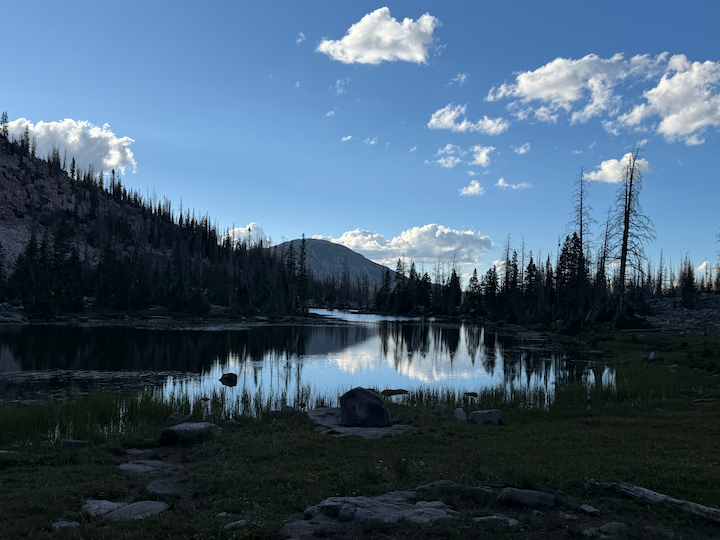
Arriving, the lake didn’t disappoint: a perfect reflection of sub-alpine firs and shore grasses against the twilight. Tent up, pads laid out, sleeping bags on top—we were set. After dinner, we walked down to the lake. My eleven-year-old granddaughter taught me the word ombré that evening, watching the blue sky turn orange and dark. A word my painterly mind was stunned I’d never learned. I’d always just called it a wash. Standing there with her and her eight-year-old sister, I was reminded I had plenty to learn.
We built a fire with what looked like a match but wasn’t—an electric lighter. The last time I was there, a flashlight with D batteries was the only power device we had. Well, not entirely true. There was the helicopter with the correct air-fuel mix that landed near our campsite to ferry our broken friend to the hospital. Another story for another time.
Now we carried headlamps, smartphones, smartwatches, an electric pump for the air pad, and my Kindle so I could finish Peace Like a River that night, along with a backup charger for everything. Technology had multiplied. We’d brought borrowed advantages by the handful.
The moment came at 1:30 AM.
I unzipped the tent to let someone out. Straight ahead, at the end of the lake barely above the trees, was the Big Dipper in its flattest form—perfectly shaped like a cooking pot, stunningly bright. Everyone craned to see it. No question which stars formed that constellation. We all gasped. My phone couldn’t capture it. The image was missed in terms of photography. But it will be forever etched in our minds.
Hiking out the next morning, I carried my borrowed advantages with me—the technology, the pad, the hope for six good hours of sleep. They’d helped get me there. But none of them could manufacture what mattered most.
That brief moment on bended knees looking out at Ursa Major made me completely present.
We hadn’t earned the moment. We’d only earned our way to the place where we could receive it.
Back at the truck, I checked my watch, and my sleep score read 83.
I passed the test. We’re going again.